Every perpetual futures trader pays or collects funding, yet most only notice it when the number stings. Funding rates are one of the most honest sentiment signals in crypto, because they are paid with real money rather than words. This guide explains what they are, why they exist, and how to use them as context instead of noise.
What a funding rate actually is
A funding rate is a periodic payment between traders who hold opposite sides of a perpetual futures contract. When the rate is positive, longs pay shorts. When it is negative, shorts pay longs. The payment usually happens every 8 hours on major exchanges, though the exact schedule varies by platform.
The key word is between traders. The exchange does not keep this fee. It is a transfer from one side of the market to the other, which is exactly why it reveals where the crowd stands.
Why perpetual futures need funding
A traditional futures contract expires. On the expiry date the price must converge with the spot market, no matter what. Perpetual futures never expire, so nothing forces that convergence. Funding is the mechanism that does the job instead.
When the perp price trades above the spot price, the market is aggressive on the long side. A positive funding rate makes longs pay shorts, which discourages buying and rewards selling pressure until prices realign. The reverse happens when the perp trades below spot. Funding is the invisible hand that keeps a contract with no expiry tethered to the underlying asset.
The tether mechanism
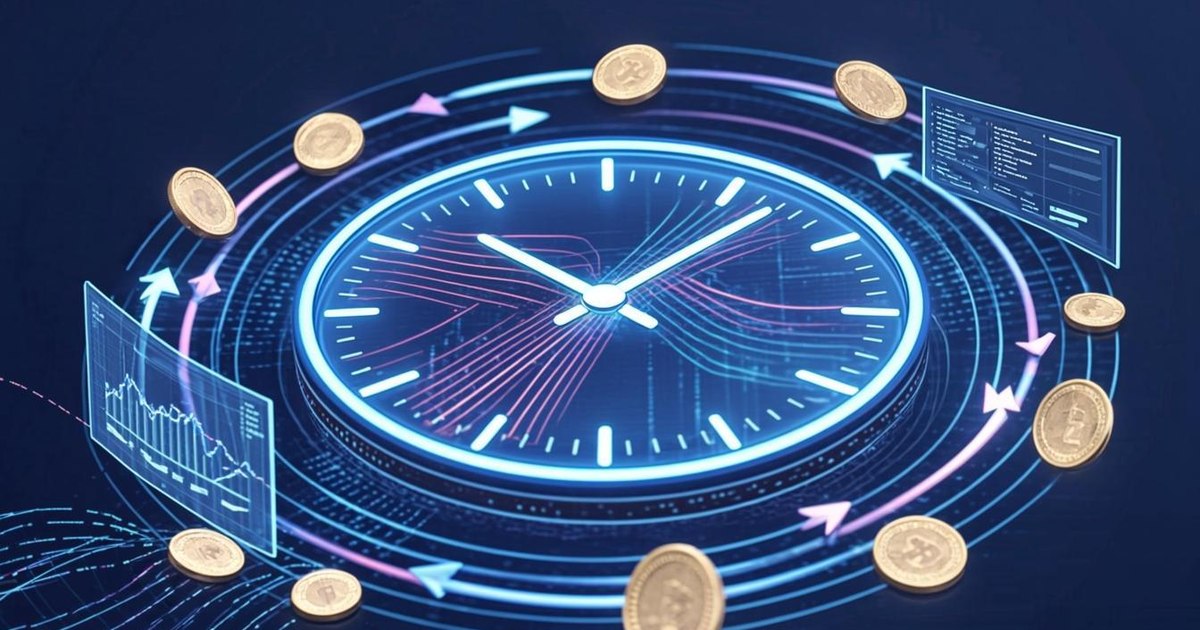
Perps never expire, so funding does the pulling: the side crowding the trade pays the other side until prices realign.
How the payment is calculated
Most exchanges compute funding from two parts. The first is the premium, which measures how far the perp price has drifted from the index price. The second is a small interest component reflecting the difference between borrowing costs of the two assets. The exact weights differ per exchange, so always read your platform's documentation.
The payment applies to your notional position value, not your margin. This is where many traders get surprised. A 10x leveraged position pays funding on ten times the collateral, because the exposure, not the deposit, is what the market prices.
Funding applies to notional, not margin
The same $1,000 of collateral at rising leverage, paying 0.05% per 8h funding. Leverage multiplies the meter, not just the risk.
| Leverage | Notional position | Funding per day | Funding per 30 days |
|---|---|---|---|
| 1x | $1,000 | $1.50 | $45 |
| 5x | $5,000 | $7.50 | $225 |
| 10x | $10,000 | $15.00 | $450 |
| 20x | $20,000 | $30.00 | $900 |
Reading positive and negative funding
Funding is a sentiment gauge with a price tag attached. Persistent positive funding means the crowd is leaning long and is willing to pay to stay that way. Persistent negative funding means the opposite. Neither direction is a signal to buy or sell on its own. The extremes are what deserve attention.
- Mildly positive funding is normal in healthy uptrends. Longs paying a small toll is the default state of bull markets.
- Very high positive funding suggests an overcrowded long side. If the marginal buyer is already positioned, what happens when the buying stops?
- Deeply negative funding suggests an overcrowded short side. This condition historically fuels sharp short squeezes, because shorts must buy back to close and their funding cost grows with every interval they wait.
Treat funding as context for your existing plan, not as a standalone trigger. A crowded trade can stay crowded far longer than expected, and funding alone has never been a complete strategy.
The cost drag traders ignore
Funding feels tiny per interval and painful per month. The table below shows the approximate monthly cost of holding a position when the market pays no price movement at all.
| Funding per 8h | Per day (3 intervals) | Per 30 days on notional |
|---|---|---|
| 0.010% | 0.030% | 0.90% |
| 0.050% | 0.150% | 4.50% |
| 0.100% | 0.300% | 9.00% |
Hold a position for a month through hot funding and you can hand over a double digit annualized cost before price moves a single point. Directional conviction and funding awareness are not optional companions. They are the same discipline.
The cost drag, visualized
Cumulative funding paid on a static position, as % of notional. At 0.10% per 8h, one quiet month hands over 9% of exposure.
A short checklist before your next leveraged trade
- Check the current funding rate and the trend of the last few days, not just one reading.
- Estimate the funding cost for your intended holding period and subtract it from your expected move.
- Ask which side is crowded. Entering with the crowd into extreme funding means paying for the privilege of being late.
- Recheck funding if your plan was to hold for days but the rate is climbing interval after interval.
- Remember that funding applies to notional value. Multiply by your leverage before you shrug.
Common mistakes worth avoiding
- Ignoring funding on positions intended to swing for weeks, where the drag quietly compounds.
- Reading one extreme funding print as a reversal signal without waiting for price confirmation.
- Forgetting that different exchanges publish different rates for the same asset, so your cost depends on where you trade.
- Treating funding as a reason to skip a stop loss. Funding costs money. No stop can lose everything. Manage both.
How WolfSeek fits into this picture
WolfSeek was built to make this kind of context faster to gather. Market Pulse gives you a live read on the broader market, and AI Token Analysis can walk through what a token has been doing, including the conditions around it, in plain language. The goal is education and structure: understand the situation, write down your own plan, and let the numbers argue with your feelings before your money does.
WolfSeek is an intelligence platform, not a trading platform. It holds no funds, executes no trades, and promises no returns. Nothing here is financial advice. Always do your own research and size your positions so that being wrong is survivable.
Frequently asked questions
What is a normal funding rate?
Many exchanges anchor the baseline near 0.01% per 8 hour interval, which annualizes to roughly 10% on notional value. Rates near that level are routine. Sustained readings several times higher, or deeply negative ones, mark abnormal conditions worth investigating.
Can funding rates predict crashes?
No indicator predicts the future reliably, and funding is no exception. Extreme positive funding has preceded corrections often enough to warrant caution, but crowded positioning can persist and even intensify. Use funding to inform risk decisions, not to forecast exact tops or bottoms.
Do you pay funding if you hold spot?
Spot has no funding. The mechanism belongs to perpetual futures. If you hedge a spot position with perps, funding becomes part of that strategy's cost or income, depending on which side you hold.
Where can I see current funding rates?
Every major exchange publishes live funding on each perp market page, usually alongside the countdown to the next payment. Aggregators also list cross exchange comparisons, which help you notice when one venue's crowd is much more one sided than another's.
Keep Learning
Funding is only one of the forces working against an oversized position. Protect yourself with crypto position sizing and the 1% risk formula, and pair the mechanics with the mindset: the Anti-Greed Manifesto explains why discipline beats prediction.