Your crypto rarely sits in one place. An exchange here, a hardware wallet there, maybe a DeFi position you forgot about. Checking your real net worth means opening four apps and doing mental math.
That math turns dangerous on a red day. You check one exchange, see a dump, and sell in panic. Later you discover your other holdings were actually up.
There are over 560 million crypto users worldwide now. That is roughly 6.8% of the planet, and most hold across multiple platforms. Around 67 million of them are in the United States alone.
Meanwhile, thieves had a record year. Security researchers counted more than $3.4 billion stolen in 2025. Another tracker logged 245 incidents and $3.63 billion lost since January 2025.
So the real question is simple. How do you see everything in one place without creating a fresh way to lose everything? The answer depends on which tracking method you pick. Let's go through all four.
Why Tracking Became a Security Decision
Portfolio tracking used to be a convenience. In 2026 it is risk management.
When every position sits on one dashboard, concentration risk shows up early. You catch the position that grew too big before it wrecks your month. That is the same discipline behind position sizing, which we covered in our risk formula guide.
It also protects you from your own instincts. Traders who see the full picture daily make fewer panic sells. Traders who check one app get spooked and dump the wrong thing. Our anti-greed manifesto exists for exactly this reason.
Method 1: The Spreadsheet (Private, Free, Painful)
This is a Google Sheet with holdings typed by hand. No third party ever sees your positions. It costs nothing, ever.
The downsides grow faster than the portfolio. There are no live prices and no history. One forgotten row quietly breaks every number below it. Spreadsheets survive a first $100 portfolio and collapse under a real one.
Method 2: Exchange Dashboards (Easy, Incomplete)
Every major exchange shows balances with live values now. Setup takes seconds, which is why most people stop here.
The catch is obvious once you feel it. The dashboard only sees its own exchange. Add a hardware wallet or a second platform and you are back to four apps. Exchange dashboards answer what one account is worth, never what you are worth.
Method 3: API-Key Trackers (Powerful, Risky)
Most tracking apps work this way. You create an API key on your exchange and paste it into the tracker. From then on, balances sync automatically.
Good tools request read-only keys, which cannot trade or withdraw. Platforms like CoinStats connect 300+ wallets and exchanges on this model. The convenience is real, and millions use it daily.
But a read-only key is still a live credential on someone else's servers. A fake support agent can phish it in one chat. A tired click during setup can expose it. And some leaks come from breaches the platform never announces.
Attackers have learned to love these keys. They rarely withdraw funds directly. Instead they manipulate prices on thin pairs and drain victims through their own accounts. The theft looks like bad trading, so victims blame themselves.
Zoom out and the picture gets worse. Researchers tracked $3.63 billion stolen across 245 incidents since January 2025. Audited platforms accounted for the majority of those losses. Bigger brand does not mean smaller risk.
The lesson is not "avoid tools." The lesson is that every credential you create is a door. Every door needs a guard.
Method 4: No-Key Tracking (The 2026 Default)
The newest category removes the door completely.
No-key trackers need nothing that can move money. Public wallet addresses cover on-chain holdings. Manual entries cover exchange balances. Live market prices do the rest.
The security logic is simple. A credential that does not exist cannot be leaked, phished, or left with wrong permissions. Nothing to guard means nothing to lose.
Independent reviews now treat this as a headline feature. Privacy-minded users search for trackers with "no API keys needed" on purpose. The category exists because people got tired of holding their breath.
You trade away some automation. Exchange balances need manual entry. Trades do not sync silently in the background. In return you keep a complete dashboard with zero attack surface attached to it.
Day to day it looks like this. You paste your public wallet address once. You type exchange balances after every deposit or trade.
That is two minutes a week for most holders. The dashboard stays current, and no exchange learns where else you hold.
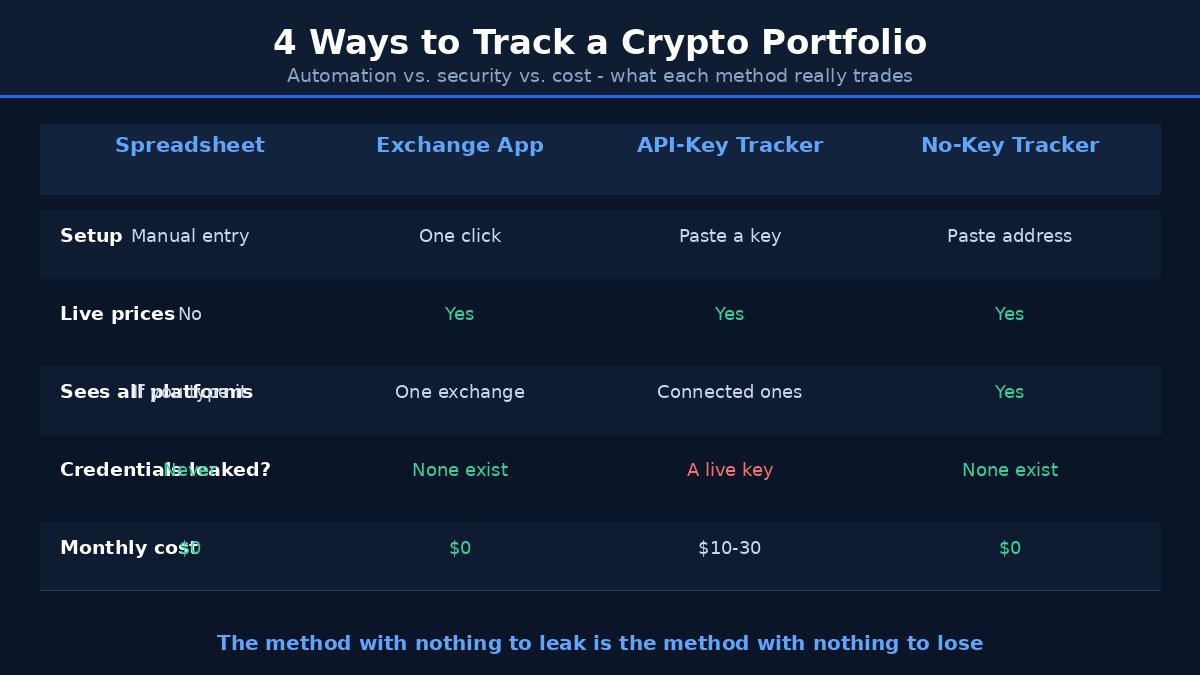
The four methods side by side
Same portfolio, four tracking styles - automation, security and cost compared
Read-Only vs No-Key: An Honest Comparison
Read-only API tracking wins on automation. Full sync, zero typing, deep exchange coverage.
No-key tracking wins on safety. Nothing exists to leak or phish. A badly configured permission cannot happen either. It works the same on every exchange, and the tracker sees your positions without ever seeing your trading identity.
The honest trade-off
What you give up and what you keep with each approach
| Factor | Read-Only API Key | No-Key Tracking |
|---|---|---|
| What it needs | An API key you create | Public address + manual entries |
| Automation | Full sync, zero typing | Two minutes a week of typing |
| What can leak | A live credential on their servers | Nothing - no credential exists |
| Coverage | Connected exchanges only | Every exchange and every wallet |
| Typical cost | $10 to $30 a month | $0 |
My recommendation for 2026 is split. Beginners and privacy-minded holders should start with no-key. High-frequency traders on one exchange can justify a read-only key. If you go that route, rotate the key monthly like real security hygiene.
Cost matters too. Good read-only trackers now charge $10 to $30 a month for full sync. No-key tracking runs on data you already own. Over a year, that difference pays for a hardware wallet.
Three Mistakes That Get People Drained
Mistake one: permission hoarding. People grant trade permissions "just in case." Then they forget. Six months later that key is still sitting there with full access.
Mistake two: never rotating keys. A key created in 2023 and never replaced has survived every phishing wave since. Rotate monthly, and an old leak stops mattering.
Mistake three: trusting any app that asks. A polished landing page is not a security audit. Check what permissions a tracker requests before you paste anything.
A 5-Minute Security Checklist
Run this today, whichever method you choose.
- Audit every API key you ever created. Delete the dead ones. Dead keys are unguarded doors.
- Keep the rest read-only. No trade permission. No withdrawal permission. Ever.
- Never paste a key because someone asked. No real support team requests keys. This is the most common phishing pattern going.
- Move long-term holdings off exchanges. Tracking a hardware wallet is easy. Recovering a breached exchange account is not.
- Check one dashboard daily. Decide from data, not from whichever app you opened first.
FAQ
Is it safe to give a tracker my API keys?
A read-only key cannot move funds. It is still a live credential sitting on someone else's servers. The risk is leakage, phishing, or bad setup. No-key tracking deletes that entire risk category.
What is the safest way to track crypto?
A method that needs no credentials at all. Public wallet addresses, manual exchange entries, and live prices. You get the full dashboard without creating anything stealable.
Do portfolio trackers need my private keys?
No. Never. A service asking for private keys or seed phrases is a scam. There are no exceptions in the history of crypto.
How many people hold crypto now?
Around 560 million globally, over 6% of humanity. Tracking has quietly become a basic money skill.
Where This Leaves You
Tracking is not optional anymore. It is the difference between managing a portfolio and guessing at one. Theft sits at record highs, so the smart default is the method that creates zero new credentials.
See everything. Surrender nothing.
WolfSeek is being built on this philosophy: trader-grade tools with security-first design. See what is inside the founding membership, and read how funding rates actually work while you are there.